White Label WordPress Maintenance: The 2026 Agency Guide
You just completed a beautiful $10,000 WordPress build for a client. You hand over the keys, send the final invoice, and your revenue drops back to zero. To stabilize your agency cash flow, you need to sell them a monthly maintenance retainer.
But there is a problem. Your core competency is design and marketing, not server administration. You do not have the internal bandwidth to manually test staging environments, patch CVE security vulnerabilities, or fix shattered WooCommerce checkouts every Friday afternoon when a plugin update goes wrong.
This is the exact operational bottleneck that makes white label wordpress maintenance so appealing to growing digital agencies. By offering maintenance services under your own brand, you generate predictable Monthly Recurring Revenue (MRR) without the technical headache.
However, in 2026, the traditional model of outsourcing this work to a third-party vendor is fundamentally changing. This guide breaks down the true economics of white-labeling, how to structure your pricing, and why top-tier agencies are replacing expensive outsourced human labor with highly profitable AI automation.
Quick Answer: What is white label WordPress maintenance?
White label WordPress maintenance is a service where an agency sells website care plans (updates, backups, security, and reporting) to their clients under their own brand name, but the actual technical execution is handled invisibly by a third party. Agencies can outsource this to a white-label vendor team, or in modern workflows, utilize automated AI platforms like SiteOps to fulfill the technical work in-house with zero manual labor, dramatically increasing profit margins.
Part 1: The Economics of the White Label Model
Agencies turn to white-labeling because it solves the “fulfillment trap.” You want the MRR of 50 maintenance clients, but hiring a full-time senior developer to manually QA test plugin updates will destroy your profit margins.
The Traditional Outsourced Model
Historically, agencies partnered with wholesale maintenance providers (like WP Buffs or Maintainn).
How it works: You sell a maintenance plan to your client for $200 a month. You pay your white-label vendor a wholesale rate of $80 a month to actually do the work. Your agency pockets the $120 difference as pure profit. The vendor interacts with your clients using an email address on your domain, so the client assumes your team is handling everything.
The Pros:
- Immediate scalability. You can sign 100 clients tomorrow without hiring a single employee.
- Zero technical liability. If a plugin update breaks the site, it is the vendor’s problem to fix.
The Hidden Cons:
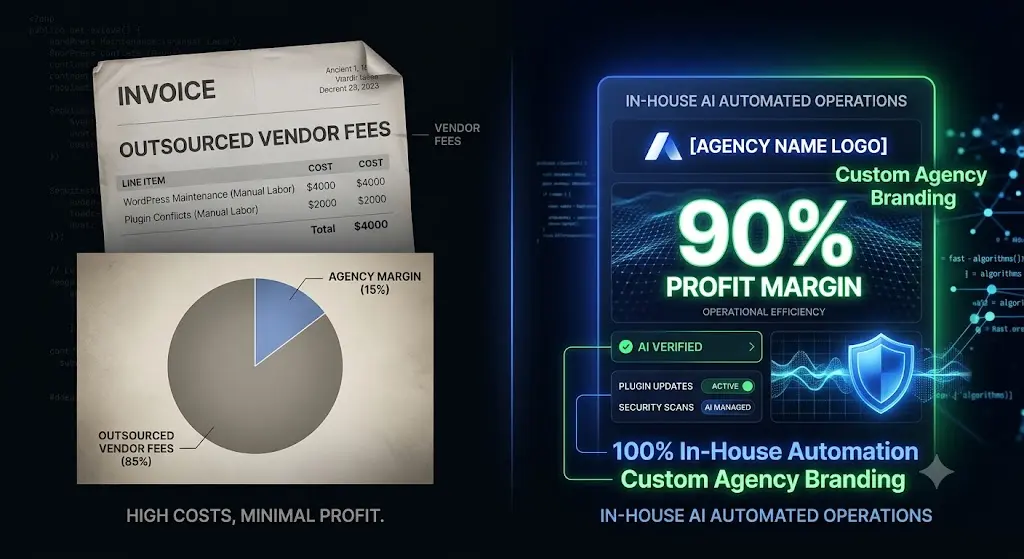
- Margin Surrender: You are giving up 40% to 60% of your gross revenue to a vendor.
- Quality Control: You have no direct control over the quality of the developer touching your client’s site.
- Response Times: If your client site goes down on a Friday night, you are entirely dependent on the vendor’s SLA (Service Level Agreement) to fix it, which can damage your agency’s reputation if they are slow.
Part 2: The Core White Label Service Checklist
Whether you outsource the labor to a vendor or automate it in-house using AI, your white label wordpress support offering must include a strict set of deliverables. You must clearly define what the client is paying for.
1. Daily Automated Off-Site Backups
Never rely on the client’s cheap shared hosting for backups. You must guarantee that if the server is compromised by ransomware, you have an isolated backup of the database and files stored on an independent cloud vault (like Amazon S3).
2. Safe Plugin and Core Updates
This is the most critical service. According to WPScan, over 90% of WordPress vulnerabilities originate in third-party plugins. You must update them. However, pushing updates blindly causes layouts to break. Your white-label service must guarantee that updates are visually verified on a staging environment before hitting production.
3. Proactive Security Scanning
Basic malware scans are insufficient. Your offering must include active Cross-Site Scripting (XSS) protection, firewall management, and real-time scanning against global CVE (Common Vulnerabilities and Exposures) databases to catch zero-day threats.
4. 24/7 Uptime Monitoring
If a client’s WooCommerce store goes offline, every minute is lost revenue. Your service must include high-frequency monitoring (checking the server every 1 to 5 minutes) and a guaranteed response protocol.
5. Branded Monthly Executive Reports
This is the linchpin of the white-label model. The client must receive a beautiful, branded report on the 1st of every month detailing the invisible labor performed to protect their site. This report is what justifies the recurring invoice.
Part 3: Pricing Strategy (How to Sell White Label Maintenance)
If you try to sell “plugin updates and backups,” the client will assign it a value of zero. You must price and pitch your service based on business continuity and risk mitigation.
Offer three distinct tiers to anchor your pricing.
Tier 1: The Essential Security Plan ($149/mo)
Target Audience: Standard brochure sites and local businesses. The Pitch: “This is an insurance policy for your digital storefront. We keep hackers out, ensure your code is stable, and guarantee we can restore your site in under an hour if disaster strikes.” What is Included: Weekly updates, daily backups, standard security scanning, and automated monthly reporting.
Tier 2: The Performance & Growth Plan ($299/mo)
Target Audience: Active lead-generation sites and B2B companies. The Pitch: “We act as your autonomous WebOps team. We optimize your database for speed to protect your Google rankings, visually verify every update so your forms never break, and provide priority support.” What is Included: Everything in Tier 1, plus daily safe updates, Core Web Vitals tracking, continuous database optimization, and 1 to 2 hours of dedicated content edit time.
Tier 3: The E-Commerce / Enterprise Plan ($799+/mo)
Target Audience: WooCommerce stores and high-traffic publishers. The Pitch: “Every minute of downtime costs you revenue. This plan provides real-time transaction monitoring and instant auto-rollbacks to guarantee your checkout flow never breaks during an update.” What is Included: Real-time hourly backups, 1-minute interval uptime checks, immediate CVE vulnerability patching, and priority Slack channel access.
Part 4: The 2026 Shift from Outsourcing to AI Automation
In 2026, the math of the traditional outsourced white-label model no longer makes sense for ambitious agencies.
If you have 50 clients on a $200/month retainer, your total MRR is $10,000. If you outsource that to a wholesale vendor at $80/site, you are surrendering $4,000 every single month just to avoid doing the work. Over a year, you are losing nearly $50,000 in gross margin.
The alternative used to be hiring an in-house developer to manually do the work, which cost just as much in salary.
Today, top-tier agencies have eliminated both the vendor and the in-house QA tester. They achieve white-label WordPress maintenance by deploying autonomous AI platforms.
How AI Replaces the Vendor
Modern platforms like SiteOps act as an autonomous WebOps team, allowing you to fulfill the retainer entirely in-house with zero manual labor.
- Visual Regression Testing Replaces Manual QA: Instead of paying a vendor to click through staging sites, SiteOps spins up a headless browser. It takes a screenshot of the client’s site, applies the plugin update, and takes a second screenshot. AI compares the two. If a CSS layout breaks, the system detects it automatically.
- Instant Auto-Rollbacks Replace the Helpdesk: If the AI detects a broken layout, it instantly triggers an autonomous auto-rollback. The database and files are restored to their stable pre-update state in seconds. The client never sees downtime, completely eliminating the need for a 24/7 human support team to fix broken updates.
- AI-Generated Reports Replace Account Managers: The most tedious part of white-labeling is compiling data into client-friendly PDFs. SiteOps uses AI to analyze the month’s raw data (uptime stats, security blocks, layout breaks prevented) and generates a human-readable executive summary, stamped with your agency’s logo.
Scaling Margins Infinitely with SiteOps
By replacing outsourced human labor with AI software, you fundamentally change your agency’s economic model.
If you are using a standard ManageWP alternative or a self-hosted MainWP alternative, you are likely paying a-la-carte fees per site, which penalizes your growth.
SiteOps was engineered specifically to protect agency profit margins. The SiteOps Agency Plan operates on a flat monthly rate for unlimited sites.
If you manage 50 clients, your software overhead is fixed. If you scale to 250 clients, your overhead remains exactly the same. You are no longer surrendering 40% of your revenue to a white-label vendor. Every time you close a deal and sign a new maintenance retainer, you retain 100% of the profit margin.
Stop surrendering your recurring revenue to third-party vendors. You can automate WordPress maintenance for multiple sites autonomously.
Test the AI visual regression engine today. SiteOps is free for 3 sites, no credit card required.
Frequently Asked Questions
What is white label WordPress maintenance? It is a service where an agency sells website care plans (updates, backups, security, and reporting) to their clients under their own brand, but the technical execution is handled invisibly by a third-party vendor or an automated AI platform.
How do I price white label WordPress maintenance? Do not price based on your costs; price based on the client’s risk. Basic brochure sites should start at $149/month. Performance plans for lead-generation sites range from $299 to $499/month. High-traffic e-commerce (WooCommerce) sites should start at $799+ per month.
Is it better to outsource maintenance or automate it in-house? Outsourcing to a human vendor forces you to surrender 40% to 60% of your gross profit margin. In 2026, top agencies prefer automating maintenance in-house using AI platforms (like SiteOps), which eliminates manual labor while retaining 100% of the profit margin.
How do I safely update client plugins without breaking their site? Never push bulk updates blindly to a live production site. You must either pay a vendor to manually test updates on a staging server, or use an AI maintenance platform that utilizes visual regression testing to detect layout breaks and execute auto-rollbacks instantly.
What is visual regression testing in WordPress? Visual regression testing uses a headless browser to take a screenshot of a client’s site before an update, and another screenshot immediately after. AI compares the images pixel-by-pixel to automatically detect visual breaks, missing elements, or layout shifts.
What should a white label maintenance report include? A professional report must be branded with your agency logo. It should not just list raw technical data. It should include an executive summary explaining the business value of the work performed, highlighting uptime, security threats blocked, and specifically, any disasters prevented by safe updates.
What is the best tool to manage white label WordPress maintenance? For agencies prioritizing safety and high profit margins, SiteOps is the leading platform. Unlike legacy remote-control tools, it uses AI visual regression testing and instant auto-rollbacks to verify updates, allowing agencies to scale their MRR without hiring internal QA staff or external vendors.
Can WordPress automatically update plugins safely? Native WordPress auto-updates are highly risky for agency clients because they execute blindly. They push the new code without verifying if it broke the frontend layout or CSS. Safe automation requires a dedicated third-party tool with visual verification.
How do I overcome the client objection that they will update it themselves? Explain that clicking the update button is easy, but fixing the site when the update breaks the layout is hard. Inform them that plugin conflicts frequently shatter website designs, and your agency uses visual regression testing to automatically roll back bad updates before their customers ever see a broken page.
What are CVE vulnerabilities in WordPress? CVE stands for Common Vulnerabilities and Exposures. It is a public database of known security flaws. Over 90% of WordPress hacks come from third-party plugins. Your white-label service must include proactive CVE tracking to patch exploits before hackers strike.
The Bottom Line
Building a solid maintenance retainer model is mandatory for stabilizing your agency’s cash flow. However, recurring revenue is only valuable if it is highly profitable.
If you rely on expensive third-party vendors to execute your white-label services, you are artificially capping your own revenue potential and surrendering control over the quality of work.
The modern WordPress ecosystem demands autonomous operations. By implementing an AI WordPress maintenance platform that utilizes automated visual regression testing and intelligent reporting, you can offer enterprise-grade care plans entirely in-house.
You protect your clients’ revenue, secure your agency’s reputation, and radically preserve your profit margins.
SiteOps automates the entire workflow. Claim your free site today.
Scale Your Agency Today
Join 500+ agencies automating their WordPress maintenance. Get started with 3 sites for free. No credit card required.