How Digital Agencies Use Automated QA to Justify Higher Maintenance Retainer Fees
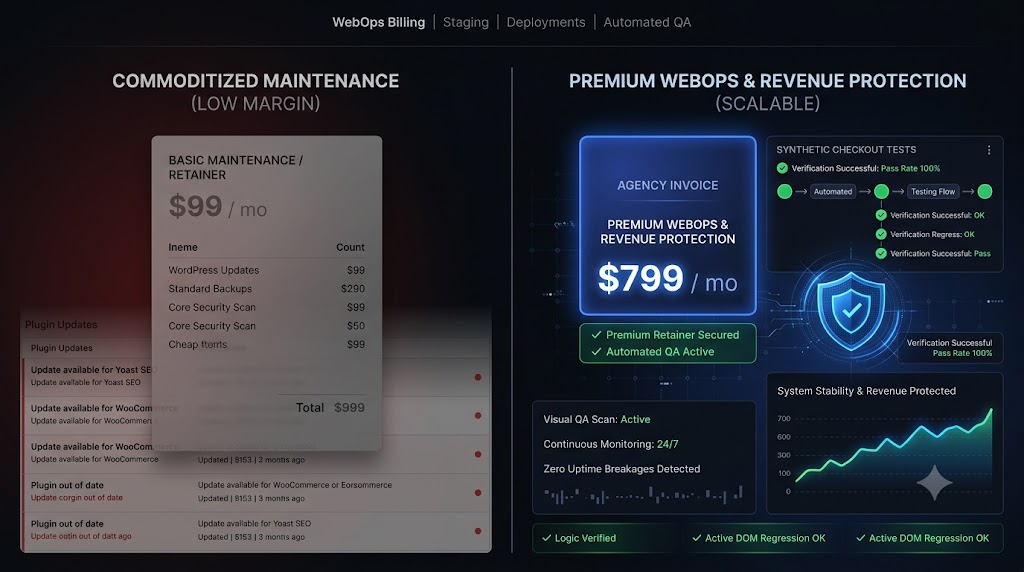
You are sitting in a pitch meeting with a prospective client. They run a successful WooCommerce store doing $10,000 a day in sales. You pitch your standard website maintenance package for $150 a month, outlining weekly plugin updates and off-site backups. To build a profitable wordpress maintenance retainer, you need to demonstrate measurable value beyond routine maintenance.
The client leans back and says, “My hosting company already does daily backups, and we can just click the update button ourselves. Why should we pay you?”
If you sell maintenance by listing technical tasks, you will constantly lose to cheaper freelancers or do it yourself hosting features. Plugin updates have become a commodity. Backups have become a commodity. You cannot build a highly profitable WordPress maintenance retainer by selling commodities.
To close high ticket retainers ranging from $500 to $1,500 a month, you must completely shift the conversation. You must stop selling technical chores and start selling automated revenue protection.
This guide breaks down exactly how top tier digital agencies leverage advanced Quality Assurance (QA) technology like visual regression and synthetic transaction testing to reposition their value, justify premium pricing, and close larger retainers with zero friction.
Quick Answer: How do you justify a higher WordPress maintenance fee?
To justify a higher WordPress maintenance fee, agencies must shift their pitch from “performing updates” to “guaranteeing business continuity.” By utilizing automated QA platforms like SiteOps, agencies can promise clients that a bot will visually verify their site and physically test their WooCommerce checkouts or lead forms after every update. This proves the agency is actively protecting the client’s revenue from broken code, justifying a premium monthly retainer.
The Problem with Pitching “Updates and Backups”
Before you can raise your prices, you must understand why clients push back on standard pricing.
When a business owner sees a line item for “Weekly Plugin Updates,” they visualize a task that takes three seconds to complete. They log into WordPress, see a notification bubble, click it, and the notification disappears. To them, the perceived value of this action is zero.
If you try to explain that pushing updates blindly can cause fatal PHP errors or shatter a CSS layout, you sound like you are fear mongering. They want proof of your value, but traditional legacy dashboards (like a basic ManageWP alternative) only provide static PDF reports listing updated version numbers.
Version numbers do not justify a $500 monthly invoice.
The Value Shift: Selling Revenue Protection
To charge premium rates, you must align your service with the client’s core business objective. They want to make money. You are no longer a website mechanic. You are a digital security guard protecting their revenue engine.
Here are the three specific technological features modern agencies use to execute this value shift, and the exact sales scripts used to pitch them.
1. Pitching Synthetic Checkout Testing (For E-Commerce)
If a client runs a WooCommerce store, their greatest fear is a broken checkout page. A hidden cost of broken WordPress updates is that a single conflicting JavaScript file can hide the Stripe credit card input fields, effectively closing their business while the server stays perfectly online.
Basic WordPress monitoring tools cannot detect this. But automated QA can.
The Premium Sales Pitch: “Because your store processes high volume transactions, clicking ‘Update All’ is incredibly dangerous. A minor plugin patch can easily break your payment gateway integration. We do not just update your site; we utilize autonomous synthetic transaction bots. After every single update we run, a headless browser autonomously adds a product to your cart, navigates to checkout, and mathematically verifies that your payment fields rendered correctly. We physically test your ability to make money every time code changes, guaranteeing you never suffer a silent checkout failure.”
A client generating $10,000 a day will gladly pay $800 a month for this level of absolute transaction certainty.
2. Pitching Visual Regression Testing (For Brand Integrity)
For B2B companies, law firms, and high end service providers, brand perception is everything. If a theme update shatters their mobile navigation menu or deletes their primary hero image, it destroys their credibility with prospective clients.
The Premium Sales Pitch: “Your website is the first impression for high ticket clients. We cannot risk a software update breaking your visual layout. To ensure absolute brand integrity, we use AI driven visual regression testing. Before we apply a security patch, our system takes a pixel perfect snapshot of your live site. It runs the update, takes a second snapshot, and uses AI to compare them. If a single button shifts or a menu breaks, the system instantly and autonomously rolls your site back to its stable state. Your customers will never see a broken webpage.”
This positions your white-label WordPress maintenance service as an advanced enterprise solution, instantly elevating you above competitors offering manual services.
3. Pitching Proactive Forensic Security
Every agency promises “security scanning.” Usually, this just means installing a free plugin that checks a public blacklist once a day. Clients know this and refuse to pay a premium for it. You must sell proactive, deep forensic defense.
The Premium Sales Pitch: “Standard security plugins live inside WordPress, meaning sophisticated hackers can easily trick them. We operate differently. Our WebOps platform sits outside your server and performs a 4 level deep forensic audit daily. We verify your core files against official cryptographic checksums, scan the raw database for hidden backdoor accounts, and cross reference your active plugins against global CVE vulnerability databases in real time. If a zero day threat is announced, we know instantly and patch it before automated botnets can target your data.”
By articulating a superior, highly technical WordPress security monitoring protocol, you justify a massive price increase.
How to Execute This Profitably
Selling a $1,000 a month retainer using these pitches is entirely possible. But if you have to hire a full time QA engineer to manually perform staging tests, process fake credit card transactions, and write custom SQL security queries to fulfill these promises, your profit margin will collapse.
You must decouple the execution of the service from your agency’s billable hours.
To automate WordPress maintenance for multiple sites and retain 90% profit margins on premium retainers, top tier agencies utilize SiteOps.
SiteOps: The Engine Behind High Ticket Retainers
SiteOps was engineered specifically to provide agencies with the enterprise grade features required to sell premium care plans, without requiring human labor to execute them.
When you connect a client to the SiteOps WordPress maintenance tool, the platform acts as your autonomous WebOps team.
- It Executes the QA: SiteOps natively performs the visual regression testing and synthetic WooCommerce checkout testing you promised the client, automatically rolling back the database if an update fails. You never have to log into a staging server.
- It Delivers the Proof: Premium retainers require premium reporting. SiteOps uses AI to generate branded executive summaries that highlight the exact disasters prevented (such as layout breaks caught by the AI or CVE threats patched). You deliver undeniable proof of ROI every month.
- It Scales Infinitely: When comparing a MainWP alternative or standard SaaS tools, pricing is critical. SiteOps offers a flat rate Agency Plan for unlimited sites. Whether you sign 10 premium clients or 100, your software overhead remains exactly the same, allowing you to maximize your margins.
Stop Competing on Price
If you pitch standard maintenance, you will always be dragged into a race to the bottom. There will always be a freelancer willing to click the update button for fifty dollars a month.
You must elevate your offering. By integrating safe WordPress updates backed by AI visual regression and synthetic transaction testing, you transition from selling technical chores to selling absolute business continuity.
You protect your clients from catastrophic revenue loss, and in return, you command the premium retainer fees your agency deserves.
Stop acting as a manual QA tester and start selling automated WebOps.
Test the SiteOps visual regression engine today. Claim your free sites, explore the automated checkout testing, and upgrade your agency pitch tomorrow.
Frequently Asked Questions
How do I pitch WordPress maintenance to a client? Stop pitching technical features like database optimization and core updates. Pitch business continuity. Frame the retainer as a digital insurance policy equipped with AI automated QA that ensures broken plugin updates never take their checkout page or lead forms offline.
How do you justify a higher WordPress maintenance fee? To justify a higher fee, you must offer enterprise grade risk mitigation. By utilizing automated platforms like SiteOps, agencies can promise clients that a bot will visually verify their site layout and physically test their WooCommerce checkouts after every code update.
How much should I charge for WordPress maintenance? Pricing should reflect the client’s business risk and the level of automated QA provided. Basic brochure sites with visual testing start at $149 a month. Active lead generation sites range from $299 to $499 a month. High traffic WooCommerce sites requiring synthetic transaction testing should start at $799+ a month.
What is synthetic transaction testing in WordPress? Synthetic transaction testing is an automated process where a headless browser acts like a real user. It adds an item to the cart, navigates to the checkout page, and visually verifies that all form fields and payment widgets loaded correctly after a plugin update.
What is visual regression testing in WordPress? Visual regression testing uses a headless browser to take a screenshot of a client’s site before an update, and another screenshot immediately after. AI compares the images pixel by pixel to automatically detect visual breaks, missing elements, or layout shifts.
How do I prove the value of a maintenance retainer every month? The best way to prove ongoing value is through an automated monthly report. Do not just send raw server data. Use AI tools to generate an executive summary that highlights the specific disasters you prevented, such as layout breaks avoided by auto rollbacks or active zero day threats patched.
Why is an HTTP 200 check not enough for premium maintenance? An HTTP 200 status only confirms the server responded. A site could suffer a shattered Elementor layout or a missing WooCommerce checkout button, and the basic monitoring bot will still receive a 200 OK status, falsely reporting the site as healthy. Premium maintenance requires visual verification.
How do agencies fulfill premium retainers profitably? Top tier agencies eliminate unbillable human hours. They use automated AI WordPress maintenance platforms like SiteOps that utilize visual regression testing to verify frontend layouts autonomously, combined with flat rate software pricing to protect gross margins as the portfolio scales.
What are CVE vulnerabilities in WordPress? CVE stands for Common Vulnerabilities and Exposures. It is a standardized public database of known security flaws. Premium maintenance plans must include proactive CVE tracking, where platforms cross reference installed plugins against this database to patch exploits before hackers strike.
How do I safely update client plugins without breaking their site? Never push bulk updates blindly to a live production site. To fulfill your high ticket contract safely, you must either manually test updates on a staging server, or use an AI maintenance platform that utilizes visual regression testing to detect layout breaks and execute auto rollbacks instantly.
Scale Your Agency Today
Join 500+ agencies automating their WordPress maintenance. Get started with 3 sites for free. No credit card required.