How to Test WordPress Updates Before Applying Them (The Agency Guide)
You see a notification in your dashboard: a critical security patch is available for WooCommerce. You know you need to update it immediately to protect your client’s revenue. But you also know that WooCommerce updates are notoriously fragile. If you click update and a database migration fails, or a CSS class shifts, the checkout page will break, and the client will lose thousands of dollars.
You cannot push the code blindly, but you cannot ignore the security risk. You must test the code first.
If you run a web agency or manage high traffic websites, understanding how to test wordpress updates before applying them is the foundation of your entire maintenance operation. Over 90% of WordPress vulnerabilities originate in third party plugins, making updates mandatory. However, blindly applying them to a live production environment is a massive operational liability.
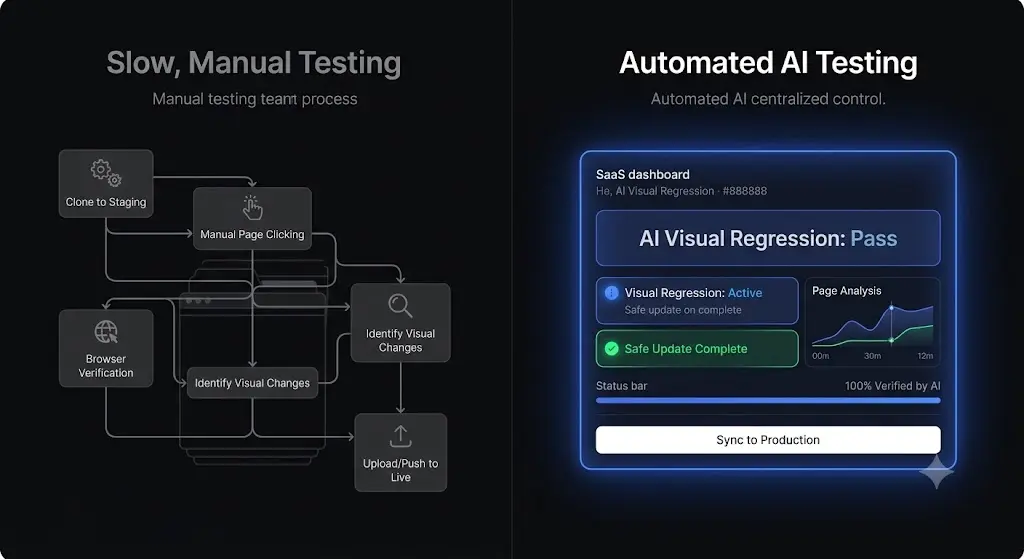
This guide provides the exact technical protocols for safely testing WordPress updates. We will cover the traditional manual staging method, explain why it destroys agency profit margins at scale, and detail how modern agencies use AI visual regression testing to automate the entire QA process.
Quick Answer: How do you test a WordPress update safely?
To test a WordPress update safely, never apply it directly to your live production site. First, create a staging environment (an exact clone of your live site). Apply the plugin or core updates to the staging site. Next, manually click through key pages (homepage, contact forms, checkout flows) to verify no visual layouts broke or functions failed. Once verified, you can safely push the updates to the live site. For automated testing, agencies use visual regression tools to capture before and after screenshots, eliminating manual checking entirely.
The Liability of Blind Updates
Before establishing a testing protocol, it is critical to understand why testing is necessary in 2026. The WordPress ecosystem is vastly more complex than it was five years ago.
When you click “Update” on a plugin, you are altering the integration between your core system, your theme, and potentially dozens of other plugins. This can trigger three specific types of catastrophic failures:
- PHP Syntax Fatal Errors: If the updated plugin requires a newer PHP version than your server is running, the syntax mismatch will immediately trigger the “White Screen of Death.”
- DOM and CSS Layout Shifts: This is the most insidious failure. A minor update to a caching or optimization plugin might defer a critical JavaScript file improperly. The server will not crash, but your client’s mobile navigation menu will simply disappear.
- Database Schema Migrations: Major updates often alter how data is stored. If a WooCommerce database update script times out, the database tables become misaligned, and users will be unable to complete purchases.
You cannot rely on legacy “Safe Update” features that simply check for an HTTP 200 server response. An HTTP 200 code only means the server is online; it does not verify if your CSS grid shattered. You must verify the frontend.
The Traditional Protocol: Manual Staging Environments
If you manage a single, high revenue website without access to automation tools, you must execute the manual staging protocol. This is the only way to guarantee safe WordPress updates without specialized software.
Step 1: The Pre-Flight Backup
Never rely solely on your hosting provider’s automated daily backups. Before initiating any testing sequence, trigger an immediate, manual backup of both your files and your MySQL database. Store this backup off site. If a server error locks you out of your hosting panel, you still control the recovery data.
Step 2: Deploy the Staging Clone
A staging site is an exact, isolated sandbox replica of your live production site. It allows you to test code changes without real visitors seeing the process.
- Using your hosting control panel or a dedicated staging plugin, push your live database and files to a staging URL (e.g.,
staging.yourdomain.com). - Ensure search engines are explicitly blocked from indexing the staging site to prevent duplicate content penalties.
- Log into the staging WordPress dashboard.
Step 3: Incremental Execution
Do not click “Update All” on the staging site. Bulk updating removes your ability to isolate a problem if the site crashes.
Update the plugins sequentially. Start with minor utility plugins, move to optimization tools, update the core theme, and finish with major operational plugins like WooCommerce or membership tools. Clear the staging cache after every significant update.
Step 4: Manual Quality Assurance (QA) Testing
This is where you act as a human tester. You must manually verify the integrity of the Document Object Model (DOM) and core functionality.
- Visual Check: Load the homepage on desktop and mobile. Check for CSS shifts, missing fonts, or broken image containers.
- Functional Check: Test all primary conversion points. Submit a test contact form to ensure the API is firing.
- Transactional Check: If it is an e commerce client, add an item to the cart and proceed completely through the checkout flow.
Step 5: The Production Push
Once the staging site passes all visual and functional tests, you can push the staging environment back to the live server (overwriting the live site), or log into the live production site and confidently replicate the exact sequence of updates you just verified.
The Agency Bottleneck: Why Manual QA Fails at Scale
The manual staging protocol is safe. But if you run an agency, it is an operational nightmare.
If you want to build a profitable WordPress maintenance retainer, you must strictly control your overhead. Let us run the math on manual testing.
If you charge $150 a month for a maintenance retainer:
- Cloning to staging: 5 minutes.
- Executing incremental updates: 5 minutes.
- Manual visual QA testing: 15 minutes.
- Pushing back to production: 5 minutes.
That is 30 minutes of highly focused, unbillable labor per client, per week. If you manage 40 client sites, you are burning 20 hours a week just verifying that plugin updates did not shatter a CSS grid. Your senior developers are acting as human click testers.
The hidden cost of broken WordPress updates is not just the downtime; it is the unbillable labor required to prevent it. You cannot manage multiple WordPress sites profitably if every new client requires human verification.
The Modern Standard: Automating QA with Machine Vision
To scale a maintenance portfolio, you must replace human QA testers with autonomous AI.
Top tier agencies have moved beyond manual staging environments. They automate WordPress maintenance for multiple sites by shifting to intelligent platforms that perform visual regression testing natively.
Visual Regression Testing Explained
The only way to guarantee safety without human intervention is visual regression testing. This treats the website exactly like a human visitor would, but with pixel perfect machine accuracy.
- The Baseline Snapshot: Before any update occurs, the system spins up a headless browser. It visits the live production site and takes a pixel perfect snapshot of the DOM and high resolution screenshots of key pages.
- The Execution: It applies the plugin updates autonomously.
- Cache Purge: It automatically clears the server caching layers to ensure it is viewing the newly compiled live code.
- The Comparison: It takes a second set of screenshots.
- AI Variance Analysis: Artificial intelligence overlays the images. It easily differentiates between expected dynamic content (like a new blog post) and a fatal layout break (like a missing navigation menu).
Instant Autonomous Auto-Rollbacks
Visual regression is powerful, but detecting a broken site does not save you time if you still have to manually log in via FTP to fix it.
True automation requires active remediation. When a modern WordPress maintenance tool detects a layout break during an update, it instantly halts the process. Within seconds, it queries your backup vault and triggers an autonomous auto rollback.
The database and files are restored to their exact pre update state before the client or their customers ever see the error.
Automating Testing with SiteOps
When you build a business on WordPress maintenance retainers, your management software dictates your profit margin and your operational liability.
If you are searching for a ManageWP alternative or a MainWP alternative because you are tired of manual testing, SiteOps is the definitive solution.
SiteOps completely eliminates the need for staging environments for routine maintenance. It fundamentally redesigns the agency workflow by introducing an autonomous AI operational layer.
When you trigger a bulk update across your client portfolio via SiteOps, you stop acting as a manual QA tester. The platform executes the visual regression testing, acts as the human eyes, and autonomously reverts any update that causes visual variance.
By pairing this automated visual testing with native 5 minute WordPress uptime monitoring and proactive 4 level deep WordPress security monitoring, SiteOps handles the heavy lifting natively. It then synthesizes this data into AI generated executive summaries, creating the perfect white-label WordPress maintenance reports to prove your value to your clients.
Stop letting manual staging tests bottleneck your agency growth. You can scale your recurring revenue infinitely when your software handles the verification work for you.
Test the visual regression engine today. SiteOps is free for 3 sites, no credit card required.
Frequently Asked Questions
How do I test a WordPress plugin update before installing it? You should never test plugin updates directly on a live site. You must clone your website to an isolated staging environment, run the update there, and manually verify the frontend layout. Alternatively, use an automated maintenance platform that utilizes visual regression testing to verify the update for you.
Why is it important to test WordPress updates? WordPress is a complex ecosystem. An update to a plugin can conflict with your theme, alter CSS classes, or require a newer PHP version than your server runs. Testing ensures these conflicts do not break your live website and cause downtime for your visitors.
What is a WordPress staging site? A staging site is a private, exact replica of your live production website. It is used as a sandbox environment where developers can safely test new code, plugin updates, or design changes without affecting the public facing website.
Can WordPress automatically update plugins safely? Native WordPress auto updates are highly risky because they execute blindly. They push the new code without verifying if it broke the frontend layout or CSS. Safe automation requires a dedicated third party tool with visual verification.
What is visual regression testing in WordPress? Visual regression testing uses a headless browser to take a screenshot of your site before an update, and another screenshot immediately after. AI compares the images pixel by pixel to automatically detect visual breaks, missing elements, or layout shifts.
How do agencies safely manage updates for multiple clients? Top tier agencies no longer use manual staging tests because they are unprofitable at scale. They use automated maintenance platforms like SiteOps that utilize AI visual regression testing to detect layout breaks and execute instant auto rollbacks.
What happens if an update breaks my WordPress site? If a plugin update breaks your site and you are locked out of the dashboard, you must access your server via FTP. Navigate to the wp-content/plugins folder and rename the folder of the plugin you just updated. This forces WordPress to deactivate it and will restore access.
Why did an HTTP 200 check miss my broken layout? An HTTP 200 status only means your client’s server responded to a request. A WordPress site could have a completely shattered CSS layout, a missing WooCommerce checkout button, or a broken lead form and still return a 200 OK status to a basic legacy ping bot.
How do you prove the value of maintenance updates to clients? Do not just send a raw PDF listing updated plugins. Use an automated reporting tool that pulls data directly from your management dashboard. Modern AI tools can translate technical data into clear, non technical executive summaries that prove the business value of your retainer.
Does automated visual regression testing slow down client sites? No. Advanced platforms like SiteOps process the heavy lifting, like visual regression testing image rendering and AI analysis, entirely on their own cloud infrastructure. They interact with your client’s site via lightweight API calls, resulting in zero performance impact.
The Bottom Line
Pushing code blindly to a live production environment is an operational risk that modern agencies cannot afford to take.
If you rely on legacy bulk update tools, you are forced to spend hours performing unbillable manual Quality Assurance tests on staging servers just to guarantee safety.
By implementing AI WordPress maintenance platforms that utilize automated visual regression testing and instant auto rollbacks, you guarantee the visual integrity of every update. You protect your clients’ revenue, secure your agency’s reputation, and radically preserve your profit margins.
Stop manually testing plugins. SiteOps automates the entire workflow.
Scale Your Agency Today
Join 500+ agencies automating their WordPress maintenance. Get started with 3 sites for free. No credit card required.