Your WooCommerce Checkout Is Probably Broken (And You Do Not Know It)
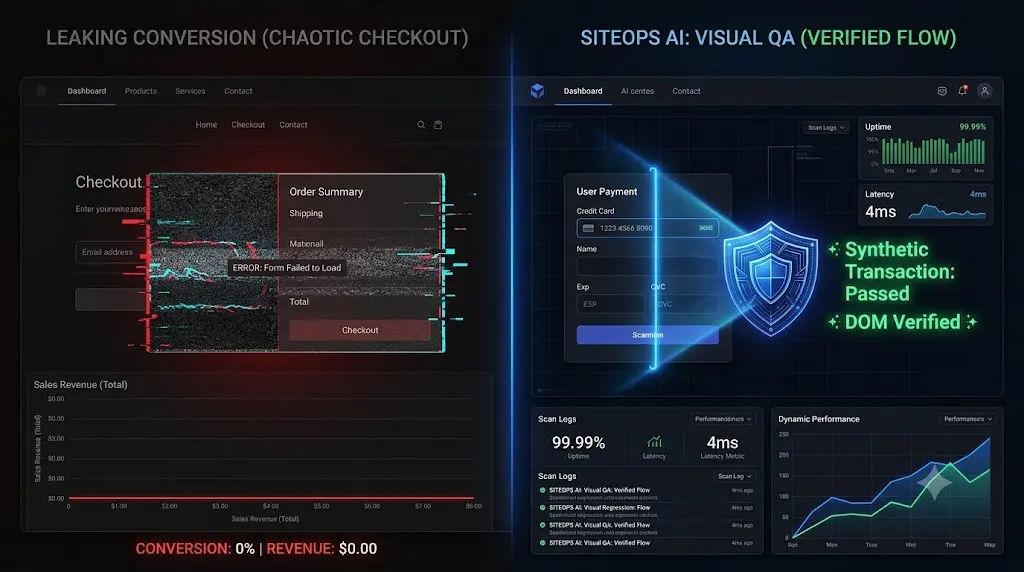
Imagine logging into your agency dashboard on a Monday morning. Your client, a high-volume WooCommerce retailer, usually processes $5,000 in weekend orders. Today, their sales dashboard reads zero a broken woocommerce checkout may be silently costing them sales.
You immediately check your server monitoring software. It displays a bright green checkmark. The server is online. The uptime is 100 percent. The site loads in under two seconds.
You visit the live website. You browse the product catalog. Everything looks perfect. You click “Add to Cart” and proceed to the checkout page. The page loads, but the credit card input fields are completely missing.
The site is online, but the business is functionally dead.
This is a silent checkout failure. It is the most terrifying scenario an agency owner can face. When you manage an e-commerce retainer, your client expects you to protect their revenue. If an update breaks their checkout on a Friday night, and you do not find out until the client realizes their bank account is empty on Monday, you have failed your core objective.
This guide exposes the exact technical reasons a broken woocommerce checkout occurs silently. We will explore why the tools you trust are actively lying to you, the true financial cost of these invisible errors, and how top tier agencies automate their testing to guarantee transaction stability.
Quick Answer: What causes a broken WooCommerce checkout?
A broken WooCommerce checkout is usually caused by outdated custom theme template overrides, aggressive JavaScript minification from caching plugins, or conflicting updates to payment gateway APIs like Stripe or PayPal. These conflicts cause the checkout Document Object Model (DOM) to fail silently. To prevent this, agencies use automated visual regression testing and synthetic transaction bots to visually verify the checkout fields render correctly after every single plugin update.
The Anatomy of a Silent Checkout Failure
To protect an e-commerce client, you must understand exactly how WooCommerce renders its most critical page. The checkout is not a static HTML document. It is a highly volatile integration of third party APIs, complex database queries, and dynamic JavaScript.
When the checkout fails silently, it almost always stems from one of three architectural conflicts.
1. The Theme Template Override Conflict
Custom WordPress themes rarely use the default, visually plain WooCommerce checkout layout. Theme developers copy the core WooCommerce files (located in the woocommerce/templates/checkout/ folder) into their own theme folder to heavily customize the design.
When WooCommerce releases a major core update, they frequently alter the underlying structure and PHP hooks within those default template files. If your client’s custom theme relies on an old, overridden template file that no longer matches the new WooCommerce core structure, the integration shatters.
The server will not crash. However, the checkout fields will either misalign terribly, throw a hidden PHP error in the background, or simply fail to render the “Place Order” button.
2. Aggressive Caching and JavaScript Minification
Modern payment gateways like Stripe do not process credit cards directly on your server. To comply with PCI regulations, they load an isolated iframe via external JavaScript to capture the card details safely.
When you install a performance optimization plugin (like WP Rocket or LiteSpeed Cache) to improve Core Web Vitals, these tools aggressively defer or minify JavaScript files to speed up the page load.
If your caching plugin incorrectly defers the specific JavaScript required by Stripe or PayPal, the payment gateway will never initialize. The customer will see their order summary, but the box where they type their credit card number will be completely blank.
3. Payment Gateway API Disconnects
Payment providers update their APIs constantly to improve security. If you update the WooCommerce core but leave your Stripe or Square extension outdated, the integration will fail to communicate with the external payment processor.
The user might be able to enter their card details and click “Pay,” but the server will return a silent AJAX failure. The loading spinner will simply spin forever.
Agency Reality Check: You are required to update plugins to patch vulnerabilities. But every time you update an optimization plugin or a payment gateway, you risk triggering a silent checkout failure. You must test the transaction flow.
Why Standard Monitoring Tools Miss the Breakage
If you use a legacy WordPress monitoring tool to watch your client sites, you are highly exposed to these silent failures.
The HTTP 200 Status Fallacy
Standard uptime monitors are simple ping bots. Every five minutes, they send a request to your server. If the server responds with an HTTP 200 OK status code, the dashboard logs the site as healthy.
An HTTP 200 code only means the server is turned on. It does not look at the actual website.
If your CSS grid completely collapses, the server still returns a 200 OK status. If a JavaScript conflict hides your payment fields, the server still returns a 200 OK status. If a plugin update broke site functionality entirely on the frontend, standard tools will still tell you everything is perfectly fine.
You cannot monitor a modern WooCommerce store with a simple ping bot. You must monitor the frontend user experience.
The True Cost of an Invisible E-Commerce Failure
When a brochure website goes offline for an hour, it is an inconvenience. When an e-commerce checkout breaks, the financial damage is immediate and measurable.
Immediate Revenue Loss
Let us assume your client averages $500 an hour in sales. If a plugin update breaks their checkout at 5:00 PM on Friday, and you do not discover the issue until 9:00 AM on Monday, the site has been functionally dead for 64 hours.
Your agency just cost that client $32,000 in hard revenue.
Abandoned Carts and Wasted Ad Spend
The damage extends beyond the missed sales. If your client is running $1,000 a day in Facebook or Google Ads traffic directly to their product pages, that money is entirely wasted. They paid to acquire high intent traffic, only to send them to a broken checkout experience.
Furthermore, data from the Baymard Institute indicates that complex or broken checkout flows are the primary driver of cart abandonment. A user who experiences a broken payment form will not wait for you to fix it. They will immediately purchase from a competitor.
The Loss of Agency Trust
When a client discovers a woocommerce payment gateway not showing before you do, your credibility vanishes. They are paying you a monthly retainer to manage their technology. If you push an update that breaks their revenue stream and you are unaware of it, they will terminate the contract. The lost MRR (Monthly Recurring Revenue) directly impacts your agency’s valuation.
The Flawed Solution: Manual Checkout Verification
To prevent these disasters, responsible agencies execute a strict woocommerce update checklist.
To guarantee safety without specialized software, your team must perform intense manual Quality Assurance (QA) testing.
- You clone the live production site to a staging environment.
- You run the plugin updates.
- A developer manually visits the staging site.
- They add an item to the cart.
- They navigate to the checkout page.
- They input sandbox credit card credentials and submit a test order.
- They log into the WordPress backend to verify the order processed correctly.
- They repeat this exact update sequence on the live production site.
Why Manual QA Kills Agency Margins
This manual workflow is safe, but it is an operational nightmare.
Executing this level of woocommerce checkout testing takes a senior developer roughly 30 minutes per client, per week. If you manage 20 WooCommerce retainers, your team is burning 10 hours a week acting as human click testers.
If your agency bills at $150 an hour, you are losing $1,500 in potential revenue every single week just to verify that a caching plugin update did not hide a Stripe input field. You cannot scale a maintenance business if every client requires intense manual human verification.
The Modern Standard: Automating Checkout Verification
To protect your clients’ revenue and your own profit margins, you must decouple the execution of updates from human verification. Top tier agencies have abandoned manual staging tests. They use advanced WebOps platforms to automate their QA processes entirely.
This specific bottleneck is exactly why we engineered SiteOps. SiteOps does not just push code; it acts as an autonomous QA tester, completely eliminating the risk of a silent checkout failure.
Here is exactly how the SiteOps engine guarantees transaction stability.
1. AI Visual Regression Testing
The only way to guarantee that a layout did not break is to look at it. SiteOps achieves this through pixel perfect visual regression testing.
Before you execute an update, the system spins up a headless Chromium browser in the cloud. It visits your live production site and takes a high resolution snapshot of the Document Object Model (DOM) across the critical e-commerce path (Shop Archive, Single Product, Cart, and Checkout).
It then applies the plugin updates autonomously and flushes the server caching layers.
The headless browser returns and takes a second set of screenshots. Artificial intelligence overlays the images. It easily detects a fatal layout break, such as a missing “Place Order” button or a shattered CSS payment form.
2. Synthetic Transaction Testing
SiteOps goes beyond static images to verify business logic. To ensure the database and APIs survived the update, the headless browser executes a synthetic transaction.
It autonomously adds a product to the cart, navigates to the checkout page, and visually verifies that the required payment widget DOM elements (like the Stripe iframe or the PayPal button) successfully rendered on the screen. It confirms that the customer can actually type in their credit card number.
3. Instant Autonomous Auto-Rollbacks
Detecting a broken checkout is powerful, but it does not save the client’s revenue if you still have to manually log in via FTP to fix it. True automation requires active remediation.
If the SiteOps AI detects that the custom theme overrides failed and shattered the CSS, or if the synthetic transaction bot confirms the Stripe fields are missing, the system halts immediately.
Within seconds, SiteOps triggers an autonomous auto-rollback. The MySQL database and file system are restored to their exact stable pre update state.
The client never experiences downtime. Their customers can still check out. You simply wake up to a dashboard notification explaining exactly which plugin failed the visual QA test, allowing you to investigate on a staging server when you are ready.
Stop Updating Blindly
Understanding how to update woocommerce plugins safely is the first step in taking control of your agency’s liability.
If you manage e-commerce retainers using legacy bulk update tools that rely on simple server pings, you are actively deploying risk. A ping bot cannot tell you if your checkout is broken.
By implementing an autonomous WordPress maintenance tool equipped with AI visual regression and synthetic transaction testing, you protect your clients’ revenue, secure your agency’s reputation, and radically preserve your billable hours.
Stop manually testing plugins on staging servers. Let the AI handle the verification.
Test the visual regression engine today. SiteOps is free for 3 sites, no credit card required.
Frequently Asked Questions
Why is my WooCommerce checkout not working? A broken checkout is usually caused by outdated custom theme template overrides that no longer match the new WooCommerce core files, or by third party payment gateway extensions (like Stripe or Square) that conflict with aggressive JavaScript minification from a caching plugin.
How do I fix a broken WooCommerce checkout page? First, clear all WordPress and server level caches to ensure a stale file is not causing the conflict. Second, navigate to WooCommerce > Status to check for outdated theme templates. Finally, use an FTP client to rename recent plugin folders to isolate the specific code conflict causing the breakage.
How do I test a WooCommerce checkout safely? Never test an update directly on a live site. You must clone the site to a staging environment, apply the updates, enable your payment gateway’s Test Mode, and manually process a sandbox transaction. Alternatively, use an automated platform like SiteOps to run synthetic visual transaction tests autonomously.
Does updating WooCommerce delete my products or orders? No. A routine plugin update only replaces the core software files, not the database where your products and orders are stored. However, if a required database update script fails during the process, data corruption can occur, which is why a pre update backup is mandatory.
What is visual regression testing for WooCommerce? Visual regression testing uses a headless browser to take a screenshot of your product and checkout pages before an update, and another screenshot immediately after. AI compares the images pixel by pixel to automatically detect visual breaks, missing checkout buttons, or shattered CSS layouts.
Why did my monitoring tool miss my broken checkout? Legacy monitoring tools only check for an HTTP 200 OK status code. This means your server is turned on and responded to a request. Your WooCommerce site could have a completely broken CSS layout or a missing payment gateway, and the basic monitoring bot will still falsely report the site as healthy.
Can WordPress automatically update WooCommerce safely? Native WordPress auto updates are highly risky for e-commerce sites because they execute blindly. They push the new code without visually verifying if it broke the frontend layout or the checkout flow. Safe automation requires a dedicated third party tool with visual verification.
What happens if an update breaks my WooCommerce site on SiteOps? The SiteOps AI detects the visual layout break or missing transaction elements during the update process. Before the client or their customers ever see the error, the system autonomously triggers an auto-rollback, restoring the database and files to their stable pre update state in seconds.
How do agencies manage multiple WooCommerce updates efficiently? Top tier agencies no longer use manual staging tests for every update because they are highly unprofitable. They use automated maintenance platforms that combine bulk update capabilities with AI visual regression testing to eliminate unbillable manual QA hours entirely.
How do you prove the value of e-commerce maintenance to clients? Do not send a raw PDF listing updated plugins. Use an automated reporting tool that translates technical data into a clear executive summary. Highlight exactly how much potential downtime was avoided and how many fatal layout breaks were prevented by your proactive visual testing systems.
Scale Your Agency Today
Join 500+ agencies automating their WordPress maintenance. Get started with 3 sites for free. No credit card required.