The Anatomy of a Zero Downtime WordPress Maintenance Plan (High Tier Strategy)
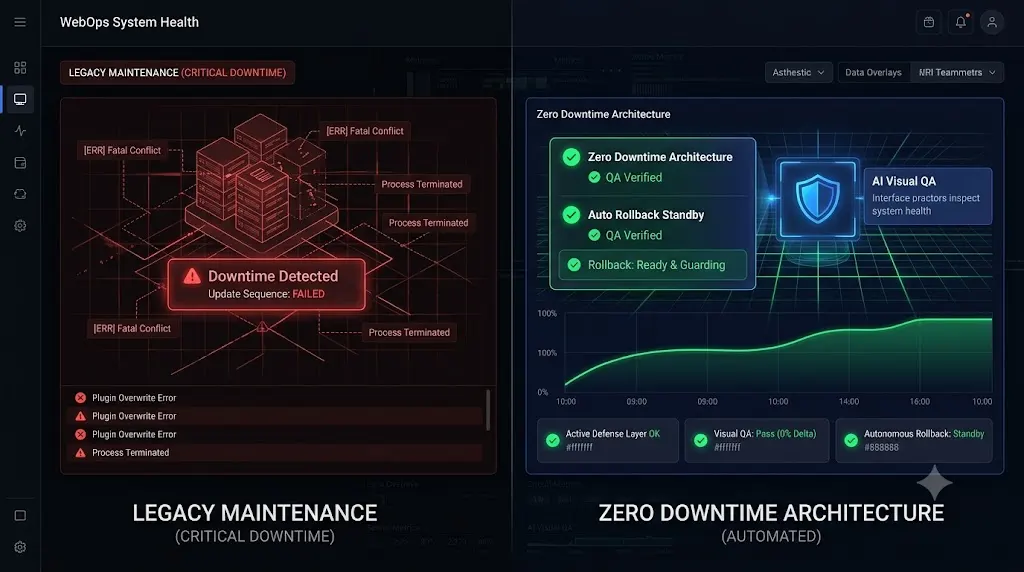
If your agency relies on legacy bulk update dashboards, you cannot guarantee zero downtime wordpress maintenance. You are simply playing the odds.
When you manage a $50 a month brochure website, an hour of downtime on a Sunday night is a minor inconvenience.
When you manage a $1,500 a month maintenance retainer for a high volume WooCommerce store, an enterprise SaaS platform, or a healthcare provider, an hour of downtime is a catastrophic breach of contract. High tier clients do not accept excuses. They do not care that a caching plugin conflict caused a fatal PHP error. They pay premium agency rates to guarantee absolute business continuity.
The problem is that the WordPress ecosystem is inherently volatile. You are required to update third party plugins to patch security vulnerabilities, but every time you push an update, you risk breaking the frontend layout or crashing the server.
To secure and service enterprise level clients, you must architect an operational stack that anticipates failure and mitigates it autonomously. This guide breaks down the exact anatomy of a zero downtime maintenance plan, why manual Quality Assurance (QA) is no longer sufficient, and how elite agencies use AI WebOps to guarantee 100% functional stability.
Quick Answer: How do you achieve zero downtime WordPress maintenance?
To achieve true zero downtime WordPress maintenance, agencies must abandon blind plugin updates. A zero downtime architecture requires four layers: high frequency uptime monitoring, deep forensic security to prevent hack related crashes, synthetic transaction testing to verify business logic, and AI visual regression testing. During an update, if the AI detects a visual layout break, it must trigger an instant, autonomous auto rollback, restoring the site to its stable state before the end user ever experiences downtime.
The Flaw in the 99.9% Uptime Promise
Almost every agency includes an uptime guarantee in their WordPress maintenance retainer. They use a basic pinging tool, see a green checkmark, and proudly report 99.9% uptime to the client.
This metric is dangerously deceptive. The HTTP 200 Fallacy dictates that basic WordPress uptime monitoring only verifies if a server is turned on. It does not verify if the website is actually working.
If you push a WooCommerce update and it shatters the CSS grid, hiding the credit card input fields, your ping monitor will still report 100% uptime. The server is fine, but the business is dead. For a high tier client, a broken checkout page is classified as downtime, regardless of what the server header says.
To provide high tier WordPress management, your definition of downtime must evolve from “server offline” to “business logic failure.”
Layer 1: Proactive Forensic Security (Preventing Malicious Downtime)
The most unpredictable cause of severe downtime is a security breach. If a botnet compromises a vulnerable plugin and executes a ransomware payload, the site goes down entirely.
A zero downtime plan requires you to neutralize the threat before the payload executes.
- The Old Way: Relying on reactive security plugins that scan for known malware signatures inside the WordPress dashboard.
- The Zero Downtime Way: Implementing a proactive WordPress security monitoring engine. This requires continuously cross referencing the client’s active plugins against global CVE (Common Vulnerabilities and Exposures) databases to patch zero day exploits instantly. Furthermore, it requires deep forensic scanning that bypasses the WordPress API to read raw database tables, hunting for invisible Ghost Admins before they can lock you out of the server.
Layer 2: Visual Regression Testing (The End of Blind Updates)
The most frequent cause of downtime is the agency itself. When you click “Update All” in a legacy ManageWP alternative, you are pushing code blindly. If that code breaks the layout, the site is broken until a human notices and fixes it.
- The Old Way: Manually cloning a site to a staging server, running updates, and paying a developer to spend an hour clicking through pages to check for broken CSS. This is slow, expensive, and leaves room for human error.
- The Zero Downtime Way: Utilizing AI visual regression testing. Before a plugin updates, a headless Chromium browser takes a pixel perfect snapshot of the live production site. It executes the update, clears the cache, and takes a second snapshot. Artificial intelligence overlays the images. It verifies the frontend layout autonomously at machine speed, completely eliminating the hidden cost of broken WordPress updates.
Layer 3: Synthetic Business Logic Verification
High tier clients rely on complex functionality. A membership site must allow logins. A B2B site must capture leads. A WooCommerce site must process payments.
- The Old Way: Hoping the forms still work after a caching plugin update, or manually filling out test forms every Friday afternoon.
- The Zero Downtime Way: Deploying synthetic transaction bots. During the maintenance cycle, an autonomous cloud bot acts exactly like a human user. It adds a product to the cart, navigates to the checkout, and visually verifies that the Stripe or PayPal payment DOM elements rendered correctly. It mathematically proves that the business logic is intact without requiring unbillable human labor.
Layer 4: The Instant Auto Rollback Safety Net
Visual testing and synthetic verification are incredible detection tools. However, detecting a broken site does not prevent downtime. If your tool simply emails you at 3:00 AM to tell you a layout shattered during an update, your client is still experiencing downtime until you wake up and fix it.
True zero downtime architecture requires active, autonomous remediation.
When evaluating how to safely update WordPress plugins, the ultimate safety net is the auto rollback.
If the AI visual regression test detects a shattered CSS layout, or if the synthetic bot fails to find the checkout fields, the system must halt immediately. Within seconds, it must trigger an autonomous auto rollback, restoring the MySQL database and file system to their exact stable pre update state.
The client never experiences the downtime. The broken code is quarantined. You wake up to a dashboard notification explaining which specific plugin failed the test, allowing you to investigate securely on a staging environment.
The Financial Impact: Selling Zero Downtime Architecture
If you pitch standard maintenance (backups and updates) to an enterprise client, you are competing in a race to the bottom. They can hire a freelancer to click the update button for $50 a month.
When you architect your agency around visual regression and autonomous rollbacks, you are no longer selling manual labor. You are selling digital insurance.
You can approach a client doing $10,000 a day in sales and pitch a $1,000 a month retainer effortlessly. You simply explain that traditional agencies use blind updates that frequently cause layout crashes, while your agency uses AI visual verification and synthetic testing to guarantee their checkout flow never breaks during a code change.
High tier clients will gladly pay a premium for absolute certainty.
Building Your Enterprise Stack with SiteOps
To execute a zero downtime wordpress maintenance plan, your software stack must match your ambition.
If you use basic management tools, you are artificially capping your agency’s revenue potential. You cannot scale enterprise contracts if your team has to manually verify staging sites or respond to midnight downtime alerts.
This operational necessity is exactly why we engineered SiteOps.
SiteOps acts as your autonomous WebOps engineer. It is the only WordPress maintenance tool that unifies deep forensic database scanning, 5 minute uptime monitoring, synthetic transaction testing, and AI visual regression into a single, flat rate dashboard.
SiteOps performs the visual QA and executes the instant auto rollbacks entirely autonomously. You can confidently automate WordPress maintenance for multiple sites, knowing that a broken layout will never reach a live production audience.
Furthermore, SiteOps translates this complex telemetry into beautiful, white-label WordPress maintenance executive summaries. You provide the client with undeniable proof that their revenue is protected, completely eliminating retainer churn.
Stop selling basic updates. Start selling zero downtime architecture.
Test the SiteOps visual regression engine today. Protect your first client sites for free.
Frequently Asked Questions
What is zero downtime WordPress maintenance? It is a maintenance strategy that guarantees a website’s frontend layout and business logic will not break during routine code updates. It requires moving away from blind bulk updates and implementing AI visual regression testing with instant automated rollbacks to catch and revert conflicts immediately.
Why do WordPress sites go down during plugin updates? Updates introduce volatile code changes. A new plugin version might require a higher PHP version resulting in a fatal syntax error, or it might alter CSS classes that conflict with a custom theme, shattering the visual layout and rendering the site unusable.
What is the HTTP 200 Fallacy in website monitoring? The HTTP 200 Fallacy is the dangerous assumption that a server response equals a healthy website. Traditional WordPress monitoring tools only check if the server is awake. A site can return a 200 OK status while serving a completely broken layout or a missing checkout button.
How do I safely test WordPress updates for high tier clients? You must decouple execution from human verification. Top agencies use automated platforms like SiteOps that utilize headless browsers to take screenshots before and after an update. AI compares the images to verify the visual layout autonomously.
What is synthetic transaction testing? Synthetic transaction testing is an automated process where a cloud bot mimics a real user. It navigates to a product page, adds an item to a cart, or clicks submit on a lead form to visually verify that the business logic of the site is intact without requiring human QA testers.
How does an auto rollback prevent downtime? If an AI visual test detects that a plugin update broke the website layout, the maintenance platform immediately halts the update process. It queries the pre update backup and autonomously restores the database and files in seconds, ensuring the end user never sees the broken site.
How do you justify a $1000 per month WordPress maintenance retainer? You justify high tier retainers by pitching revenue protection instead of technical chores. You demonstrate that an hour of downtime costs the client thousands of dollars in lost sales and ad spend, and you prove that your automated visual QA architecture prevents that downtime entirely.
Can WordPress automatically update plugins safely? Native WordPress auto updates are highly risky for enterprise or e commerce sites because they execute blindly. They push the new code without verifying if it broke the frontend layout or CSS. Safe automation requires a dedicated third party tool with visual verification.
What happens if a hacker creates a hidden admin account? Sophisticated attackers create Ghost Admins that actively lie to standard security plugins. A zero downtime architecture requires a forensic security scanner that bypasses the WordPress API to read raw database tables, instantly exposing hidden users and obfuscated malware.
How does SiteOps differ from legacy management tools? When evaluating a MainWP alternative or exploring MainWP vs ManageWP vs SiteOps, the core difference is verification. Legacy tools push code blindly and rely on HTTP server pings. SiteOps visually verifies every update using AI and automatically rolls back failures, providing true zero downtime operations.
Scale Your Agency Today
Join 500+ agencies automating their WordPress maintenance. Get started with 3 sites for free. No credit card required.